
Community
Monthly CIRC Symposia
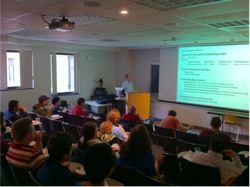
Every third Friday of the month, the Center for Integrated Research Computing hosts a research symposium (known as the CIRC Symposium), where faculty, staff, and student researchers convene to learn about research projects utilizing the center’s resources, meet potential collaborators, and learn about new technologies and trends in research computing. This event is user-driven and features presentations by researchers using CIRC systems. CIRC Symposia are open to all members of the university community.
The Center for Integrated Research Computing (CIRC) will host its next symposium on Friday, October 16th, 11:30 am – 1 pm in Wegmans Hall 1400
This month’s featured speaker is Gaston Chaumont from the Department of Economics. Gaston will demonstrate the use of a computational model for fiscal and monetary policy determination.
Our ongoing research talk will be given by Yufeng Xi from the Department of Mechanical Engineering. Yufeng will present results from a finite element analysis framework that uses machine learning for improving simulation results.
Accounting for Credibility: Fiscal-Monetary Interactions and the Credibility of Central Bank Mandates
Gaston Chaumont, PhD
Department of Economics
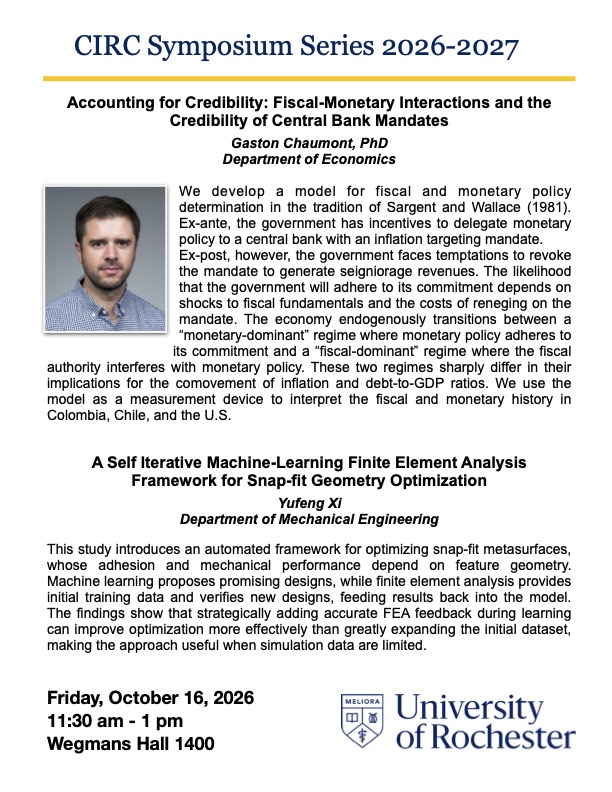
We develop a model for fiscal and monetary policy determination in the tradition of Sargent and Wallace (1981). Ex-ante, the government has incentives to delegate monetary policy to a central bank with an inflation targeting mandate. Ex-post, however, the government faces temptations to revoke the mandate to generate seigniorage revenues. The likelihood that the government will adhere to its commitment depends on shocks to fiscal fundamentals and the costs of reneging on the mandate. The economy endogenously transitions between a “monetary-dominant” regime where monetary policy adheres to its commitment and a “fiscal-dominant” regime where the fiscal authority interferes with monetary policy. These two regimes sharply differ in their implications for the comovement of inflation and debt-to-GDP ratios. We use the model as a measurement device to interpret the fiscal and monetary history in Colombia, Chile, and the U.S.
A Self Iterative Machine-Learning Finite Element Analysis Framework for Snap-fit Geometry Optimization
Yufeng Xi
Department of Mechanical Engineering
This study introduces an automated framework for optimizing snap-fit metasurfaces, whose adhesion and mechanical performance depend on feature geometry. Machine learning proposes promising designs, while finite element analysis provides initial training data and verifies new designs, feeding results back into the model. The findings show that strategically adding accurate FEA feedback during learning can improve optimization more effectively than greatly expanding the initial dataset, making the approach useful when simulation data are limited.
Information about previous CIRC Symposia is available.
CIRC Summer School
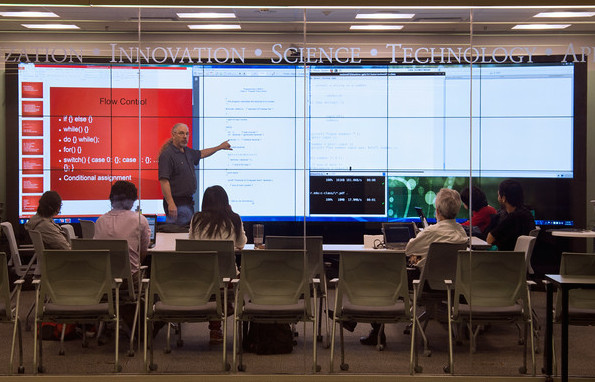
Every summer, CIRC hosts a four-week training session on various operating systems, programming languages, computational programs and libraries, and data analytics tools for the research community. Known as the “CIRC Summer School,” these workshops are broken down into individual topics and feature small, interactive, classroom-based instruction sessions. Topics range from basic training in Linux to optimizing codes for parallel computing. The courses are designed for beginner and advanced users alike. Extra emphasis is placed on using the various available languages, libraries, etc., specifically on BlueHive.
CIRC Winter Boot Camp
Have you ever wanted to learn how to program or add a new programming language to your existing knowledge? Have you been looking for the right time to pick up a few essential technical computing skills to help with your research projects or course work? Well, now you have the opportunity during the CIRC Winter Boot Camp!
The Center for Integrated Research Computing (CIRC) hosts a multi-week winter program to help students, postdocs, research staff, and faculty learn new programming languages and sharpen their computing and data analytics skills. The classes are designed for beginners and cover basic topics to give enough direction to move on to self-learning tutorials or other more advanced coursework.
CIRC Workshops
The Center for Integrated Research Computing (CIRC) offers workshops every Spring and Fall that introduce users to the BlueHive computing environment and other computing resources that CIRC supports. The workshops include sessions in the morning targeted for new and beginning users, and afternoon sessions covering a few more in-depth topics and tools and applications that are available to the research community.
Annual CIRC Poster Session
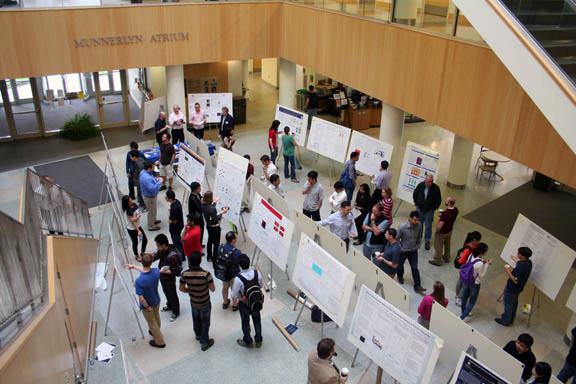
The Center for Integrated Research Computing holds the Annual CIRC Poster Session at the end of each Spring semester. At this event, attendees discover the wide range of research that is enabled by computation and displayed to the University community. This event provides an informal venue to share computational and data analytics techniques and methodologies with colleagues from a wide variety of disciplines.
Check again later for an announcement about the next CIRC Poster Session!